
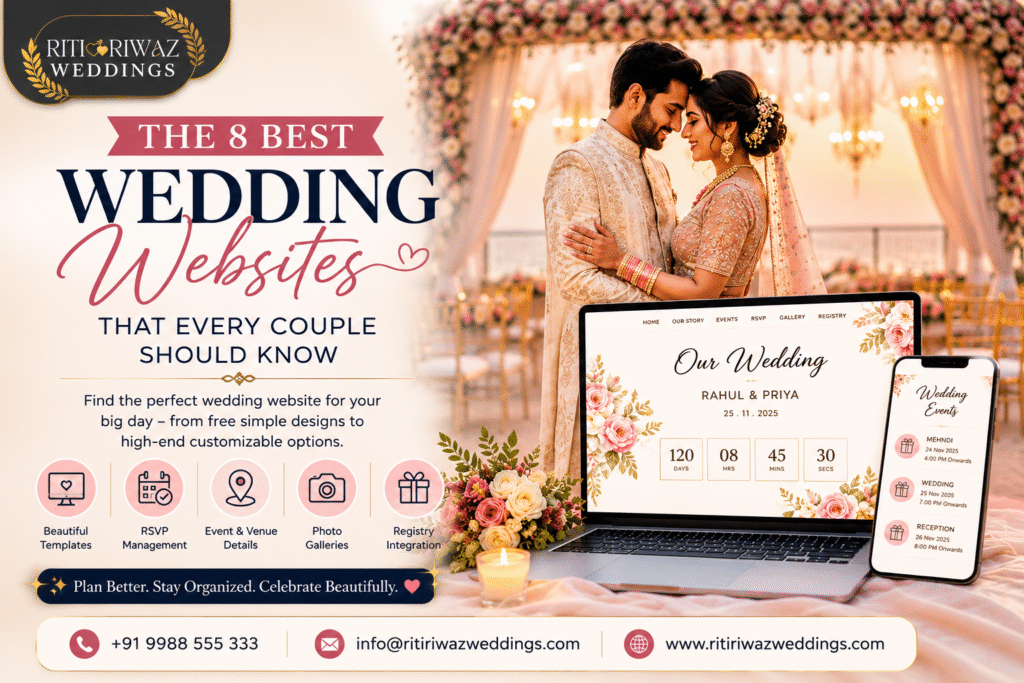
Planning a wedding involves more than choosing a venue, décor and vendors. Couples also need a simple way to share event timings, collect RSVPs, answer guest questions and communicate last-minute updates. This is where the best wedding website platforms can make wedding planning more organised.
A wedding website brings essential information into one place. Guests can check venue directions, dress codes, accommodation suggestions, transport plans and schedules without repeatedly contacting the couple or their families. It can be especially helpful for an Indian wedding with several functions or a destination celebration involving travel.
However, every website builder offers a different mix of design, RSVP tools, privacy settings and pricing. Some are made specifically for weddings, while others give couples more creative control. This guide compares nine popular options so that you can choose a platform that matches your guest list, event format and budget.
Why Create a Wedding Website?
Printed invitations remain an important part of many celebrations, but they cannot always hold every detail. A wedding website supports the invitation by giving guests information they can access and revisit from their phones.
When comparing the best wedding website platforms, begin with the information your guests will need most often rather than choosing on design alone.
Couples can use it to:
- Collect attendance responses online
- Share dates and timings for multiple functions
- Add venue maps and travel directions
- Suggest hotels and local transport options
- Explain dress codes and event-specific requirements
- Display engagement or pre-wedding photographs
- Answer frequently asked questions
- Announce schedule or venue updates
- Keep selected information private with a password
For a destination wedding, the website can also contain flight guidance, hotel contacts, airport-transfer details and a complete itinerary. The best wedding website platforms reduce scattered communication and give guests one reliable source of information.
Quick Comparison of the Best Wedding Website Platforms
Use this table as a starting point. Free features, paid upgrades and regional availability can change, so check the platform’s current terms before making a final decision.
| Platform | Best suited for | RSVP tools | Design flexibility | Free starting option |
|---|---|---|---|---|
| Joy | Couples wanting useful wedding tools in one place | Built in | Good | Yes |
| Zola | Couples who want website and registry tools together | Built in | Good | Yes |
| The Knot | Simple planning, guest and registry management | Built in | Good | Yes |
| Minted | Coordinated stationery and elegant website designs | Built in | Moderate | Yes |
| Wix | Couples wanting more control over layout and features | Available through Wix tools | High | Yes |
| Squarespace | Premium design and strong visual presentation | Customisable forms | High | Trial/paid plans |
| Say I Do | Guest organisation and multi-event planning | Built in | Good | Limited option |
| Appy Couple | Website and app-based guest communication | Built in | Moderate | Paid offering |
| Riley & Grey | Design-led luxury celebrations | Built in | Curated | Paid offering |
The right choice is not necessarily the platform with the longest feature list. Among the best wedding website platforms, the most suitable option is the one your guests can understand and use easily.
1. Joy – Best for Free Wedding Planning Features
Joy combines wedding website creation with guest-list and RSVP tools. Couples can publish their schedule, share travel information, add photographs and control which guests see specific events. This can be useful when the ceremony, reception and smaller family functions have different invitation lists.
Within the best wedding website platforms, this event-level organisation is particularly helpful for celebrations spread across several days.
Its clean interface suits couples who want a polished result without spending much time learning web design. Privacy controls are also valuable when personal details, venue information and guest photographs should not appear publicly.
Advantages:
- Online RSVP and guest-management tools
- Support for multiple wedding events
- Mobile-friendly templates
- Privacy options
- Photo, schedule and travel-information sections
Possible limitation: Couples who want complete freedom over every design element may prefer a general website builder.
Joy earns a place among the best wedding website platforms for couples who want practical features and an approachable setup.
2. Zola – Best for an Integrated Wedding Registry
Zola is designed as a broader wedding-planning ecosystem. Its websites can include online RSVPs, guest information, photographs, schedules and registry links. Couples can also add questions about meal preferences, plus-ones and other guest requirements.
The dashboard makes it easier to keep website details and responses together. This is helpful for couples who prefer one system instead of combining different tools. Some registry and shopping functions are more strongly focused on the United States, so couples in India or elsewhere should confirm whether those services suit their location.
While reviewing the best wedding website platforms, international couples should always separate universally useful website tools from region-specific registry services.
Advantages:
- Integrated website, RSVP and registry features
- Guest-list organisation
- Password-protection options
- Templates that are easy to configure
Possible limitation: Some commerce-related features may be less relevant outside supported markets.
Zola is one of the best wedding website platforms when registry integration and straightforward guest management are priorities.
3. The Knot – Best for an All-in-One Planning Experience
The Knot offers free wedding websites alongside tools for planning, guest management and registries. Couples can choose a template, add their story and photographs, publish venue information and collect responses through an RSVP page.
The platform is useful for couples who want guided setup instead of building every section independently. Its planning ecosystem is extensive, although some services and vendor information are tailored mainly to particular international markets.
This makes market relevance an important checkpoint when evaluating the best wedding website platforms for an Indian celebration.
Advantages:
- Easy website setup
- Guest and RSVP management
- Registry-linking options
- Planning tools in the same ecosystem
Possible limitation: Couples should check whether its market-specific services are useful for their wedding location.
For couples who value simplicity, The Knot remains a recognisable choice within the best wedding website platforms.
4. Minted – Best for Matching Invitations and Website Design
Minted is known for artist-designed stationery, and its wedding websites are particularly useful when couples want their digital site to complement printed invitations. The platform supports online RSVPs, registry links, galleries, travel information and password protection.
A free Minted address is available, while a personalised domain requires an upgrade. This distinction matters when comparing total cost. Minted works well for couples who value a coordinated visual identity more than advanced layout control.
Couples comparing the best wedding website platforms should include domain and design-upgrade costs in their final budget.
Advantages:
- Elegant templates created by independent designers
- Designs that can coordinate with wedding stationery
- Online RSVP and registry links
- Password and visibility controls
Possible limitation: Customisation is more template-led than it is with Wix or Squarespace.
Minted is among the best wedding website platforms for couples who want their invitations and website to feel visually connected.
5. Wix – Best for Flexible Customisation
Wix gives couples more freedom to arrange pages, change layouts and add interactive elements. Wedding templates are mobile-friendly, and Wix tools can support RSVPs, plus-one information, meal choices, guest notifications and photo galleries.
This flexibility is useful when an Indian wedding requires separate pages for the engagement, mehendi, haldi, sangeet, wedding and reception. Couples can also create dedicated sections for hotel information, transport and local recommendations.
Among the best wedding website platforms, flexible page creation can be valuable when every function needs its own timing, location and RSVP information.
Advantages:
- High level of visual customisation
- Wedding templates and photo galleries
- RSVP and guest-management options
- Password protection
Possible limitation: More choice also means more setup. Couples looking for the fastest possible launch may find a wedding-specific platform easier.
Wix stands out among the best wedding website platforms when design freedom and a customised page structure matter most.
6. Squarespace – Best for a Premium Visual Experience
Squarespace is a general website builder with professionally designed templates. Couples can create a visual story, add galleries and videos, link registries, use a custom domain and build an RSVP form to collect guest information.
It is a strong option for design-conscious couples or celebrations where photography is central to the experience. Unlike dedicated wedding services, some guest-management workflows may need to be configured manually. Couples should decide whether the design freedom justifies the extra setup and ongoing plan cost.
The balance between visual control and easy guest management differs across the best wedding website platforms, so both should be tested before purchase.
Advantages:
- Refined, mobile-responsive templates
- Strong photo and video presentation
- Custom-domain support
- Flexible forms and page layouts
Possible limitation: It may require more manual configuration than a specialised wedding platform.
Squarespace deserves consideration among the best wedding website platforms for luxury, editorial or highly visual weddings.
7. Say I Do – Best for Guest and Event Organisation
Say I Do focuses on the organisational side of wedding communication. Its tools can help couples create a website, collect RSVPs, manage guests, organise event details and prepare seating arrangements.
The ability to separate events can be valuable for multi-function weddings. Couples can share the relevant details with invited guests while keeping the overall communication manageable.
Advantages:
- RSVP and guest-list management
- Multi-event planning support
- Seating-plan tools
- Templates for different wedding styles
Possible limitation: The features available without payment may not cover every guest-list size or advanced requirement.
Say I Do is one of the best wedding website platforms for couples who care more about coordination than extensive creative design.
8. Appy Couple – Best for Website and App Communication
Appy Couple provides a wedding website together with a guest-facing app experience. Couples can publish event information, send notifications, collect RSVPs and encourage guests to share photographs.
This approach may suit a destination wedding with several days of activities, where guests need easy access to updated information while travelling. Before choosing it, consider whether most guests will be comfortable using an app in addition to opening a website.
Advantages:
- Website and app experience
- Guest notifications
- RSVP management
- Photo sharing and event updates
Possible limitation: It may be unnecessary for a small or simple celebration, and design control is more curated than open-ended.
Appy Couple belongs on a list of the best wedding website platforms for couples who want frequent mobile communication with their guests.
9. Riley & Grey – Best for Luxury Website Design
Riley & Grey focuses on distinctive, fashion-led wedding website designs. It is intended for couples who want their site to feel premium and carefully art-directed rather than like a standard free template.
The platform supports the essential information guests need, including RSVPs, schedules, travel guidance and private event details. Its higher cost means it is most appropriate when presentation is a major wedding priority.
Advantages:
- Curated luxury designs
- RSVP and guest-information features
- Privacy options
- Suitable for design-led celebrations
Possible limitation: The price may not be worthwhile for couples who mainly need a simple information and RSVP page.
Riley & Grey completes this selection of the best wedding website platforms for couples seeking an exclusive visual experience.
How to Choose the Right Wedding Website Platform
Before registering, decide what the website must do. A beautiful template will not help if guests cannot find the venue map or submit an RSVP easily.
Consider Your Number of Wedding Events
For an Indian wedding, confirm that the platform can clearly display multiple functions. If every guest is not invited to every event, check whether event visibility can be controlled by invitation group.
Test the Mobile Experience
Most guests will open the link through WhatsApp on a smartphone. Preview the site on different screen sizes and make sure dates, buttons, maps and RSVP forms are easy to use.
Review Privacy Controls
A wedding website may contain personal photographs, family names and travel details. Password protection and control over search visibility can help limit access.
Compare the Complete Cost
A free website may charge separately for a custom domain or premium template. A paid builder may include the domain but require an annual plan. Compare the final amount instead of looking only at the starting price.
Check RSVP Requirements
Decide whether you need only an attendance response or also want meal preferences, dietary restrictions, plus-one details, hotel requirements and separate replies for multiple functions.
The best wedding website platforms should simplify communication for both the couple and the guests. Avoid adding features merely because they are available.
What Should an Indian Wedding Website Include?
A clear Indian wedding website can include:
- Couple’s names and a short welcome message
- Dates and timings for every function
- Venue address, map and landmark
- Dress code or suggested colours for each event
- RSVP deadline and contact person
- Accommodation and check-in information
- Airport, railway station and local transport guidance
- Shuttle or pickup schedule
- Weather and packing suggestions for a destination wedding
- Frequently asked questions
- Emergency or wedding-help-desk contact
Keep the main navigation short. Pages such as “Events,” “Travel,” “Stay,” “RSVP” and “FAQs” are usually easier to understand than creative menu labels. When reviewing the best wedding website platforms, choose one that presents these sections clearly on mobile devices.
Common Wedding Website Mistakes to Avoid
Do not publish the website with incomplete dates or placeholder information. Avoid uploading large, uncompressed photographs that slow down mobile loading. Important instructions should appear as text rather than only inside an image because text is easier to read, update and translate.
Couples should also avoid making the RSVP process unnecessarily long. Ask only for information needed for planning. Finally, assign one person to update the website so that the invitation, family messages and online schedule do not show conflicting details.
Need Professional Help Planning Your Wedding?
A website can improve guest communication, but it cannot replace venue coordination, vendor management, décor planning, hospitality and wedding-day execution. Riti Riwaz Weddings helps couples organise celebrations in Delhi NCR and destination locations through personalised planning and coordinated support.
Couples preparing an outstation celebration can explore our destination wedding planning services. If visual storytelling is a priority, review our guidance and services for wedding photographers in Delhi and candid photography in Delhi.
The goal is to keep your online information and on-ground wedding arrangements consistent, so guests receive a smooth experience from the invitation to the final function.
Frequently Asked Questions
Which wedding website platform is best for free use?
Joy, Zola, The Knot, Minted and Wix provide free starting options, but their limits differ. Compare RSVP features, domains, templates and regional availability before selecting one.
Can a wedding website manage several Indian wedding functions?
Yes, several platforms allow couples to publish multiple events. Check whether you can restrict event details so each guest sees only the functions included in their invitation.
How early should couples create a wedding website?
Create it when the date and venue are confirmed, especially if guests need to arrange travel. For a destination wedding, publishing it several months in advance gives guests more planning time.
Should a wedding website be password protected?
Password protection is useful when the website contains private photographs, venue details or travel information. Share the password directly with invited guests.
Can guests open a wedding website through WhatsApp?
Yes. Couples can share the website link through WhatsApp, email, digital invitations or a QR code. Always test the link and RSVP form on a mobile phone before sending it.
Do couples need a custom domain?
A custom domain is optional. It can make the address shorter and easier to remember, but a free platform address is sufficient when the website is used only for invited guests.
Final Thoughts
There is no single platform that suits every celebration. Joy and Zola are convenient for built-in planning tools, Minted works well with coordinated stationery, and Wix or Squarespace provide greater design control. Appy Couple supports app-based communication, while Riley & Grey focuses on premium presentation.
Shortlist two or three options, build a sample page and test the RSVP experience before committing. The best wedding website platforms are the ones that keep information accurate, protect guest privacy and make wedding communication easier—not the ones with the most complicated feature list.
Choose from the best wedding website platforms only after testing the complete guest journey on a mobile phone.